Tuesday, July 01, 2014

I'm not too sure about Flowers

Enjoy this poem by my friend and great poet, Richard Devereux.  He and his family joined us for a walk on our lovely Malvern Hills and we took them to see the famous bluebells.


bluebells
    bluebells and beyond the bluebells bluebells
    a whole hill-side of bluebells
    the famous Blackhill bluebells
    May Day bluebells
   
    run-away bluebells
    scampering  bluebells
    drawn to the sunshine – sunshine bluebells
     ding-a-ling bluebells

    my little  girl lies in the bluebells
    in the long grasses and bluebells
    her hair is dressed with bluebells
    I see a painting – girl in the bluebells

    a cry of pain – from the bluebells
    my girl is hurt – stung – forget the bloody bluebells
    she’s been stung by a bee in the bluebells
    no – by a stinging nettle nestling in the bluebells

    there is always a nettle
    in the bluebells

Sunday, May 18, 2014

A Stunning Tale: Return of The Native by Thomas Hardy


Recently I came across a paperback of Return of the Native in a second hand bookshop and grabbed it at once.  It was a long time since I had read a novel by Thomas Hardy and this was one I had never tackled.

The trouble with reading a lot of modern fiction (especially thrillers and crime fiction which I do love) is that the dialogue and action are all important with virtually no descriptive passages.  You are carried along at a helter-skelter pace most of the time as the crime is resolved and the characters play their part for a brief moment. It's the storyline that is important, the special style of the detective and his sidekick and often there is a sameness in the characters making them mere appendages to the required action.   Such stories are marvellous when you need something to grab your attention and keep you mesmerised for a while, say at airports, on train journeys or snatched moments of rest in a busy day.  But too much of this fast food diet is like eating too many hamburgers.  Tasty and filling at the time but not really satisfying or even good for mental and emotional growth.  I always feel a need for a little bit of bon cuisine after such a diet, a yearning to delve into something more thoughtful and thought provoking after a few of the fast paced thrillers (though I have been known to live on a feast of Earl Stanley Gardner books for quite a while.  Perry Mason is quite addictive!).

I read many of the great English, Russian, French and American classics from ten years old and onwards and that is thanks to my Greek mother who had a wide ranging taste and education.  It seems amazing now but as a child I was introduced to Charles Dickens at the age of ten at our primary school.  Can you imagine this happening nowadays?  David Copperfield was the first literary book I read and loved and it led me to many other wonderful books. We had a splendid local library were we lived then and I haunted it, avid for the good books available.  Thankfully I read only classics for years, actually avoiding and even scorning 'modern' writers.  But no getting away with it - my daughter was like all our family a great reader and enamoured of crime books in particular and introduced me to crime thrillers. I thank her for it because I enjoy them so much and have since been introduced to other modern writers by her.  And some of them use stunning and wonderful opening descriptions.  One of my favourites is the writer, Nicholas Evans, (The Horse Whisperer) - just read those first few pages of The Divide - his descriptions of the snow covered mountains are sublime.


Catherin Zeta Jones as Eustacia Vye

I say 'thankfully' because the result of all these 'fast food' books is that I do now find it hard work to get into a thick, meaty classic.  They can seem so dauntingly slow and long drawn out in the description department and even the dialogue can be hard work.  People's conversations in past times weren't as snappy as ours today! 

However, I began to read Return of the Native but sadly confess that at first I struggled with the lengthy opening pages of the descriptions of Egdon Heath. (And I still wish they had been cut back by the author- just a little)  However, the brilliance of the prose, the flow of dialogue and unusual characters soon drew me into the story and in no time I was totally immersed in the unhappy lives of Eustacia Vye, her lover, Damon Wildeve, Tamsin Yeobright and the native himself, Clym Yeobright.  I began to feel more and more that the full, rich descriptions of Egdon Heath, this wild, almost desolate natural surrounding in which these people lived and loved, was as much a character as they were.  It formed them and they grew forth from it, part of Nature themselves with the same wild moods and passions that often corresponded to their dramas.  Eustacia hated it, hated the Heath and longed to escape it.  She saw no beauty in its manifold changes and colours.  For her it was a desolation that echoed the state of her own soul.  To Clym Yeobright, the heath had grandeur, beauty and a meaningfulness which the city and its bright lights never held for him.  Their different aspirations and inner lives were in total opposition and they were destined to drive one another apart.  One felt deep sympathy for all the characters in this tale.  They suffered as always the pain of misunderstandings and misapprehensions which for Hardy forms the warp and woof of life's dramas. 


Egdon Heath

'The place became full of a watchful intentness now; for when other things sank brooding to sleep the heath appeared slowly to waken and listen .  Every night its Titanic form seemed to await something; but it had awaited thus, unmoved, during so many centuries, through the cries of many things, that it could only be imagined to await one last crisis - the final overthrow. '

The Heath becomes an impassive, impersonal watcher and listener to the little fates of those who live there.  It is like some enormous Deity without pity, without anything but being itself for itself.   Human lives come and go but it has been untouched almost since the dawn of time. Night, Nature, the Great Mother is the backdrop to most Hardy stories in which the compelling and passionate lives of his characters dwindle into insignificance in the presence of Nature's ancient detachment.


Many of the lines in this book tuned into my own feelings.  'The vision of what ought to have been is thrown aside in sheer weariness and browbeaten human endeavour listlessly makes the best of the fact that is.'  Many such passages abound and ring a bell for us.  One of the stunning descriptions is of the sound of the night wind blowing through the husks of the dead harebells which can be heard in the immense silence of the heath.  Amazing.  To spend time listening like this, listening to a silence so profound that the faint sound of these brown husks can be heard like a gentle song.

I feel this is one of Hardy's best novels and I hope you agree. 

Monday, February 24, 2014

The Poetic Soul and the Dark Lover: the Haunted Bronte Women

The Bronte Parsonage


The Bronte family are perhaps one of the most outstanding literary families of all times. The sentimental myths that have grown around them and their lives since Mrs Elisabeth Gaskell published her famous, though somewhat biased biography , can now be perceived with more honesty through the work of modern biographers with more material to hand and less prejudice in favour of Charlotte.  Yet none of the fascination is lost for having a spotlight turned upon the darker corners. We can still read such works as Emily Bronte's Wuthering Heights, Charlotte's Jane Eyre and Anne's The Tenant of Wildfell Hall and ask ourselves, as did their contemporaries, how on earth did these three young women, living fairly sheltered and parochial lives in a little Yorkshire town, write such passionate and feeling masterpieces.  I invite you to look at this from a Jungian psychological perspective in which we explore the animus figure of these women.

Patrick Bronte

This was a family with a literary soul.  Patrick Brunty, their father, came from a labouring family in Ireland and changed his name to Bronte as a young man.  He achieved a great deal, studied theology at St. John's College, Cambridge, receiving his BA in 1806 and eventually was given the living at a small Church in Howarth, Yorkshire.  Patrick wrote varied articles and books on serious topics and encouraged his children to read literature and talk politics with him.  He wasn't the Victorian ogre painted by Gaskell but neither was he a tender or demonstrative father.  He left the child rearing to his wife's spinster sister, Lizzie, who came from Cornwall during the fatal illness of his wife, Maria Bronte, in order to care for his six children.  This wasn't at all strange for the times; men seldom had much to do with their children.  And certainly the children saw little of him for Patrick Bronte preferred to be left alone in his study, writing poetry, articles, organising sermons and other parish matters. There is no doubt that he was so wrapped in his own activities that he lacked sensitive care and attention to their welfare.  He meant well enough when he sent his eldest two girls, Elizabeth and Maria, to Cowan Bridge School (an institution that was to be made famous by Charlotte as the dreaded Lowood).  They were not wealthy and thus the girls needed an education in order to survive later in life as there was no guarantee they would marry.  However, the Clergy Daughters School was poorly run at the time, the food so bad that the children ate little.  First Maria died of consumption followed by Elizabeth shortly after.  It seemed to take Patrick some time to realise he would lose all his girls. His first daughter, Maria, was said to be precocious beyond her ten years and with a brilliant imagination; we can only speculate about the books she too might have written.he bitterly mourned her loss.

  Patrick hastily brought back Emily and Charlotte from Cowan Bridge and thus the remaining four children were educated at home.  Branwell, Charlotte, Emily and Anne were now left to create their own amusements and entertainments and read extensively thanks to their father's liberality and encouragement, writing vast reams of material in their childhood, making up journals and tiny little books in which they recorded the adventures of their imaginary as well as heroes and heroines who were surprisingly sophisticated and worldly.

But in the main the characters in their imaginative play reflected inner characters, portions of their own nature brought to life. There is an emotional intensity to their work from an early age.  Later we still see this intensity mixed with a down to earth Yorkshire quality which makes the male characters of the Bronte stories deeply fascinating for men and women alike.  They are real and yet unreal, passionate, insistent, wild and in the case of Heathcliffe, untamed

Anne Bronte

There is no doubt that the early death of a mother creates a trauma in the lives of children, leaving a sense of loss and abandonment. Even though Anne was too small to remember her mother, this loss is still observable in her writings.  In all the Bronte ouevre, there is seldom a warm, caring mother figure.  There is also no doubt that a mother's unlived creative and spiritual character lives on in the children she has brought to birth.  If she has not fulfilled her own creative yearnings, it is likely to be left to those who come after to try to contain her frustrated, enraged spirit it or live it out in some way.  Maria Branwell Bronte, their mother, was herself an intelligent and educated woman but an early death with uterine cancer left her no time for development of her gifts.

Jung coined the term 'animus' for the 'masculine' part of a woman's psyche and Branwell in many ways took on the role of this figure and became a scapegoat for the family.  He was too weak to sustain the greatness they wished upon him and his early talents led to nothing but drink, drugs, despair and an early death.  The unlived animus of the mother instead percolated through her daughters  in the form of those amazing  creations, Rochester, Heathcliffe and Arthur Huntingdon (who is said to be based to some extent on Branwell Bronte)  The dark animus is a part of the unlived, unconscious Shadow side which we all have.  Men and women alike have written, painted and been fascinated by the Dark Lover aspect of their souls. We have 'The Dark Lady' of Shakespeare's sonnets, the innumerable 'fallen women' of painters and writers like Zola, D H Lawrence, Rider Haggard's 'She' - as well as the paintings of Dante Gabriel Rossetti's beloved Jane Morris and his obsession with the image of Persephone, the Goddess of the Underworld. And even now this archetype has taken form as a vampire image, devouring and yet fascinating in his deadliness.

Charlotte Bronte
Thus for the Bronte children, their dead mother became the mother who had been taken by Hades, living on in her children's psyches as something unknown, unlived, consuming yet also transformative. The archetype of the Dark Lover became Rochester and Heathcliffe and Arthur Huntingdon for the girls and a devouring, destructive reality for Branwell who actually lived it all out for them - a fate which often befalls the one who is a weak sensitive link in the family wiring and blows the family fuse. As children, the Brontes invented imaginary characters that inhabited their inner worlds and imagination; war, powerful men and women figures, strange islands and countries with peculiar people. Later these figures and pent up sexual and dark images were to explode upon us as the strong male characters of their books.

Emily Bronte

In Emily's Heathcliff, we come closest to the archetype. The characters of Catherine and Heathcliff, despite their wild, dramatic passion are oddly sexless; their union is on some other plane entirely ---a cosmic union of great archetypal forces beyond our understanding.  Emily was never close to people but lived in a world of her own, a sexless free spirit, roaming the moors and at one with Nature and God.  In Rochester, we have a warmer more human element but still Jane flees from his forcefulness, pathos, despair and can only possess him when he is humbled, maimed, half blinded. Charlotte was far more dependant on warmth and contact than that of Emily.  Yet even when she at last describes in Villette the real man whom she loved and lost, she cannot be dishonest, she cannot possess him and Paul Emmanuel has to die at sea in the end.  Of them all however, Charlotte it was who married in the end and had a brief moment of happiness and normality before death claimed her also.  In Anne's Arthur Huntingdown we find a far more human character again.  Huntingdon is almost redeemable at the end and has some contrition over his evil past.

These stories all seem to show that all this family had a lack of faith that anyone could find love, be sexual and human, and not have to die because of that love- as their mother had died - as many women at that time died from the exhaustion brought about by the sexual and procreative act.  Branwell searched for love, falling for a woman much older than himself who cruelly betrayed his trust and naivete.  Emily, caught by her archetypal animus did not even search for love, her soul filled with something more mystical and divine.  The Dark Lover for her was a shadow side of God Himself.  Charlotte married at last but even then seemed at some unconscious level to feel unworthy of happiness and love. She was expecting her first child but died before she could bring into this world a real human being.  Perhaps the only one who died in peace was Anne, for unlike her character, Huntingdon, she firmly believed in her soul's redemption through the love of God and went gently into that good night.


Sunday, February 09, 2014

Another Amazing Woman: Grace Darling a Victorian Heroine


Grace Darling
Long before the tragedy of the ill fated Titanic was the sinking of the  Forfarshire.  Like the former, the ship was considered one of the greatest of Northern steamships.   It had left Hull for Dundee in Scotland on September 7th 1838 with a large quota of wealthy passengers, mainly merchants and their wives returning from holidays in England.  The ship left in good weather but on its way up North suddenly ran into a terrible storm.

Grace Darling was the twenty two year old daughter of William Darling whose family had been lighthouse keepers for many years.  In those days the keeper lived on his light with his family, a strange, wild, lonely existence.  This was especially the case here on Longstone Light, set on one of the windswept, rugged Farne islands off the coast of Northumberland.  The situation was so bleak and wild that the family were often driven to the upstairs rooms to escape the crashing waves at the base of the Light.  There was plenty to do, spinning, cleaning, gathering sea bird eggs to eat or catching birds when possible, fishing, books to read and the family members were used to their quiet life.

Longstone Light

During the early hours of the morning of the 8th September, Grace climbed up the stairs to the lantern after a Night Watch and saw a large black hulk on the distant rocks.  She wasn't sure if there were people on the wreck but couldn't rest easy unless they went out to see.  Her father told her it was impossible to take their small boat out in this foul weather; they themselves would be dashed to pieces on the jutting rocks.  It normally took three men to row it in bad weather and Grace's brothers were on the mainland at that time.  Grace may have been a small girl but she was also a brave one and said she'd take the boat herself.  her father reluctantly agreed to go with her.
Dressed in her normal muslin dress with just a small cape, her father in his seaman's clothes, they set off and on reaching the rock they found the unhappy survivors clinging desperately to the hulk and fighting to reach their little boat. They took as many as they could and then returned again and took the rest of the people back to the lighthouse and safety; it was an incredible feat.

From then on Grace was lionised and made the heroine of the nation.  But hers had been a quiet life on the light and she felt she had done nothing special.  Her father had, after all, saved countless lives himself and his father before him. However, Victorian society was as silly over its celebrities as we are today and endless portraits were made of Grace, locks of her hair requested.  She was given a small annuity and a silver gilt watch but the promiised silk dress never arrived...and she had always longed for a silk dress.
She died at the age of twenty seven, exhausted by the attention and the loss of her peaceful existence.

Saturday, November 16, 2013

Amazing English Women: Role Models of the Past


When I was a young girl in the Fifties, we had a small school library and I eagerly devoured everything there was to read.  It ranged from children's favourite classics to books of geography, history and so on.  One book I was very fond of was about the English heroines, names that were then as familiar to us all as Britney Spears and Madonna are to today's kids.  But rather a different set of role models.  It contained stirring pictures of Grace Darling who helped to rescue the survivors from the wreck of the Forfarshire, Florence Nightingale holding aloft her lamp as she moved amongst the wounded at Scutari and Elizabeth Fry with the prisoners of Newgate, a place she helped to reform.

This book left a deep impression on me, one of awe and gratitude for these brave, strong minded women who defied the attitudes of their time when women were considered as a second class race without talent, voice, or much intelligence.  Any woman who dared to stand out and show herself to be an equal if not a superior to perceived male intellect was deemed unfeminine, brazen, unchristian, or accused of neglecting her family.  So it took some courage and conviction to stride out alone against the ideal of feminine sweetness, gentleness, vapidity and colourlessness much trumpeted in Coventry Patmore's famous poem 'The Angel in the House'.http://academic.brooklyn.cuny.edu/english/melani/novel_19c/thackeray/angel.html

Nowadays, despite a far less unbalanced attitude to women, we no longer hold up such historical figures of women in the past as role models.  In fact, few children even know who they are except in the vaguest manner, don't even spot their image on their £10 and £5 banknotes.  Most young people seldom even use banknotes, do they? - but wield their piece of plastic instead.  Role models now are pop stars, actors, sporting figures perhaps.  Some of these figures are worthy, especially the latter, but many are not and simply appeal to a youthful desire to be rich or simply to 'get on the telly.'  Few girls now want to be nurses or do good for those less fortunate than themselves.

Elizabeth Fry on the £5 banknote (to be replaced by Churchill)

So I hope to write a few lines now and then to remind us about these incredible women of the past.  Let's begin with my favourite:

Elizabeth Fry

Elizabeth Fry
 Elizabeth was born Elizabeth Gurney, her father a banker in Norwich and her mother part of the Barclays family.  Her mother died when she was twelve years old and as an older daughter, she had her hands full helping to raise the younger siblings.  She enjoyed a good life when young and admitted to loving dancing and riding in a scarlet habit!  However, at the age of 18 she attended a Quaker meeting and was deeply moved by the words of the American preacher, William Savery.  From then on she adopted the simple, unadorned Quaker dress.
In 1813 she married Joseph Fry another banker and also a Quaker and had eleven children by him. She managed her household duties perfectly well but always found time to visit the poor children in the school and workhouse at Islington.
Her real work began when she visited Newgate prison in the company of Sir Fowell Buxton's sister.  She was horrified by the overcrowded state of the prisons, the women and children living together in vile conditions of dirt and damp.   Some of the women had not even been tried in court but simply arrested and flung into these hell holes.  Elizabeth returned the next day with clothes and food and even stayed the night with them, inviting other members of the public to come and see for themselves what it was like in there.  The prisoners loved her and she gained their respect.  She eventually managed to set up schools for the children, appointing one of the inmates as a governess.  The women gained some self respect and began to see to their washing and cleaning and made efforts to improve themselves.  No one else was going to do it.  Matrons were installed in the prisons where before they had been overseen by men and one can only guess what that might mean.
Edith Sitwell reminds us in her article about Elizabeth Fry in the above wartime book that a 'destitute child of nine was committed to death for stealing four pennyworth of children's paints.  Eventually, after considerable delay, the sentence was commuted.  To what? Transportation to Botany Bay?' (English Women:  Edith Sitwell)

Les Miserables was fact not fiction. Here in Britain and also Europe and everywhere else in so called 'civilised' countries.  Mercy was an unknown quality.

Elizabeth's influence became great and she was supported by Queen Victoria.  Other monarchs admired her and even the Czar of Russia was influenced by her.  When he visited the debtor's prison, three old men threw themselves at his feet and begged for his mercy.  He told them that their considerable debts would be paid by him, an astonishing act of kindness in a harsh and stern regime. Mrs Fry visited Copenhagen and spoke to the monarchs there about slavery, the state of the prisons and persecution of various religious sects and was befriended by the Kind of Prussia who came to visit the prisons himself.  She founded a school for nurses that later inspired Florence Nightingale. These were just a few of the societies, libraries, schools and other institutions which this amazing and indefatigable womae set up. 

 She was said to be a warm and wonderful person who moved all to tears when she prayed with them. 
Prayer, she said, was always in her heart.  'Even in sleep I think the heart is lifted up.' And as she lay dying of a stroke in 1845 her last words were, 'Love, all love, my heart is filled with love for everyone.'

The seamen flew a flag at half mast for her passing, an honour reserved for royalty.  And thousands stood in silence at her burial.  A truly noble lady.


Monday, August 12, 2013

Echoes of the Great War

Echoes of the Great War


In August 1984,  Radio 4 ran a programme on an intriguing War diary kept by a rector called Dr Andrew Clark .  By a strange coincidence this was the name of my 'hero' in The Long Shadow, a story of World War One as it was experienced by the Allies in Salonika, Greece.  My husband was busy sorting out a load of old newspapers and copies of the Radio Times that he's kept all these years for various reasons of his own and this article caught my eye as he rifled through them  

The real Andrew Clark was a quiet scholarly rector in the peaceful village of Great Leighs in Essex.  He was born in 1856 in Dollar, Clackmannanshire.  As a young man he went on to Oxford and took a first class degree in Greats, returning to Scotland where he married and had children.  He eventually moved to Oxford where he became known as a skilled historian.  He left Oxford with some reluctance due to the fact that his wife hated university life and preferred the quiet of a rural backwater such as Great Leighs proved to be  He was a popular and successful rector there and well liked by his contemporaries.

Dr. Andrew Clark
When war was declared in August 1914, Clark decided that he would collect as much information as possible about the reactions and events that occurred to ordinary people as the war progressed.  No one dreamt it would last as long as it did or that one million British soldiers would not return home again.  Clark's historical background served him well and with meticulous care and a keen eye for observation he determined to note everything he heard or saw relating to the War, from air raids to billeting, and from health issues to news of fatalities.  He also collected letters, recorded rumours and conversations he overheard, compared them to the officially released news with all their edited propaganda and useless information.
He also collected ephemera, recruitment posters, pasted and transcribed letters from soldiers in Flanders, Salonika and Italy that had been sent to villagers and commissioned the local schoolchildren to write essays with their impressions of any events that took place locally. For instance there was the occasion when 8,000 troops marched through the village on the way to war.  At the time the children would have been enormously thrilled and excited by such a spectacle in a quiet farming village like Great Leighs where life had been slow quiet and orderly for centuries.   He also wrote to his daughter in Scotland and gathered news from whatever sources he could find such as YMCA officials, travelling salesmen, wounded soldiers, men on leave and academic men in Oxford.
Dr Clark wrote up his diaries at night and noted events hour by hour until the 28th June 1918, when the war ended with the signing of the treaty of Versailles.  He had once been a curator at the Bodleian library and the librarian there encouraged Clark to send in his diaries as each one was compiled, foreseeing that these would have value one day as records of the period as seen from the ordinary lives of people who were not soldiers but nonetheless drawn perforce into what was in effect a 'people's war'.  There was not one, city, town, village or family in Britain that remained unaffected.  Even Great Leighs, a small village of 600 people, sent 72 men to war and 19 of these never returned.
These books lay forgotten in the Bodleian library for 70 years but were at last published as Echoes of the Great War in 1985, edited by Dr James Munson who also gave the talk on radio 4.

St Mary the Virgin, Great Leighs
Lyon Hall home of the Tritton family
My interest aroused, I recently made a visit to the village, Great Leighs.  It was always a spread out village, now bordered by a great deal of new housing.  The trees had grown and little remained of the wide empty country lanes of early last century.  However, we began with the church where the Rector held his services, St Mary the Virgin.  This attractive little church has an unusual tower.  In the graveyard we found many of the Tritton family who had lived at Great Leighs for years and still do live there at Lyon Hall opposite the church. 

Poor Dr Clark!  He had quite a walk from his own home at the Rectory to the church.  Imagine doing this in the dark of a snowy winter morning or early evening, hardly any heating allowed in the church because coal was rationed.  Yet, he seldom allowed himself to shirk his duty unless sick.

The Old Rectory
We found the Old Rectory, now looking very magnificent with wrought iron gates and sweeping driveway.  I suspect Andrew Clarke would have liked to see it looking as smart as this.  He struggled hard to keep up the work and the big garden during the war years when his groom/gardener, Charles Ward, was taken away to fight.  Charles had come to work for him as a lad of fifteen in 1909 and was responsible for the pony, drove the trap when required, looked after the paddock, kitchen garden, orchard and lawns, drains and various other jobs.  For this he got 16 shillings a week.  Dr Clark did his best to keep Charles at home with him because the young man was short in stature and did not have the required chest measurement.  Other village lads were at first rejected on such grounds and felt very upset.  They had thought it would be good to be paid to enlist and see Egypt, Malta, France or Germany.  It was still considered a splendid opportunity to see the world and get away from the village and the hard work of farming and labouring.

Dr Clark did his best to keep Charles Ward with him because the young man suffered badly from weakness of the chest and wet weather would send him to hospital at once. However, letters to the Recruitment Office were of no avail as they considered that if the young man could do all that work, he should manage army life.   Dr Clark, however,  knew he wouldn't be of much use to them on the Front and sure enough, young Ward was in hospital within a few weeks of joining up.  As soon as he was well, he was sent back to the front again.  He adored the Rector and wrote regularly with his news; simple, ordinary little letters of a country lad, but often quite touching.
Meanwhile the ageing Rector struggled with the upkeep of his home, his sick and dying wife, though he made no allusion to his private life in the diaries. He was also obliged to join a form of Home Guard as he was too old to go to war himself.  This meant walking around at night, patrolling the streets and lanes to ensure all light were out and no strangers hanging about.  Spy stories were constantly flying about and anyone vaguely foreign looking or odd was regarded with deep suspicion.  Zeppelins were often heard going close by and making bombing raids on nearby Chelmsford.

Some of the stories brought back by soldiers on leave were truly horrendous.  They put paid to the official bulletins which gave away little or nothing of the true state of affairs in order to keep up morale at home.  But the problem was that rumours then flew around, fuelled by gossip and were
often more alarming than the truth. 

Little by little old class systems were being swept away and even women were being called upon to work as all the able bodied men had to enlist.  The girls had as yet, a confused idea of identity and could at times dress in a rather comic fashion, unsure whether to look like a man or a woman.  Nothing like as elegant as in a BBC TV production, I'm afraid, where they all look pretty and smart!.  Andrew Clark describes a day when he saw some land girls walking through the village dressed in riding breeches, a long smock over these, an ordinary woman's hat atop their heads and a rattan cane in hand.  There was still a good deal of disapproval of girls who worked on the land or in factories and often from other women.  The wages, however, were high and many local girls went off to do factory work, spending the money as fast as they earned it and flaunting their 'wealth'.  But when the war ended and munitions factories closed down, wages also lowered with the resultant discontent and difficulty in re-adjustment for both men and women.
It was a strange period in human history and the diaries of Dr Andrew Clark have captured it in all its everyday detail full of moments of pathos, deep meaning and ridiculous trivia and gossip.
the End Way, Great Leighs


Wednesday, July 17, 2013

The Changing Vision of the Bronte Legend


Lately I had a fit of tidying and sorting my bookshelves and came across three little volumes called The Story of English Literature  published as Murray's Literature Series in 1908.  These were only a few of the original series intended for use at colleges and in schools.  (Children learned about real literature in those days.)  My three volumes spanned the Elizabethan era to the nineteenth century.

I sat down to read them knowing that many of the views and attitudes of 1908, a period of Edwardian history, would influence and colour these worthy commentaries on our gems of English Literature – nor was I wrong.  The writers and compilers of these volumes had the usual moralistic and religious tone of the time which now seems so outmoded.  So much research has since been done, many biographies written and meticulously researched with more detachment than was possible then, plus letters and other data have come to light.  We can now view the great ones with modern allowances for drug taking, romantic and sexual misadventures, political extravaganzas.  We can view things through psychological interpretations and deeper understanding of the flaws of human nature that go to colour and instil a man or woman with the genius of creativity.  We can wonder at their brilliance but not feel we must whitewash their character to suit the sensibilities of the times.  But is that really true?  Works once hailed as the best are coloured by a new sense of morality.  Rudyard Kipling has lost much of his one time popularity because he is now seen as a relic of the jingoistic, outmoded attitudes of the British Empire.  However, he still holds his own because stories like Kim and The Jungle Book are philosophic and great imaginative creations.

Tim Dalton and Zelah Clarke were for me the best interpreters of the story

This shift in attitude certainly applies to the work of the three Bronte sisters, Charlotte, Emily and Anne.  At the time that Jane Eyre and Wuthering Heights were published in 1846, the works were regarded with some astonishment and even much disfavour at first.  The unmistakable power of the novels was recognised and made them instant successes.  But they soon began to receive condemnation from the moral brigade who declared these stories were too outspoken. In one unkind review, Jane Eyre was reviled as 'if written by a woman it was one who for some reason had long forfeited the society of her sex.'  Women were meant to be 'the angel in the house,' quiet, decorous, unseen,  The boldness with which, for instance, Jane raises herself above her 'station' and dares to declare her love for Rochester, so much her social superior, was anaethema in those days.  You knew your place.  A governess declaring her love so passionately and boldly to her master!  How awful!  How unwomanly!  But Jane refuses to accept his superiority.  Where, after all, does it lie, she wonders?  His may be superiority of education, rank, sex but she is far superior to him morally and in the purity and innocence of her heart and mind.  And she is not afraid to declare it.
my very favourite Rochester, Tim Dalton

 Let us suppose the synopsis of Jane Eyre was to be sent to a modern publisher; they would surely refuse it outright.  The story now seems slightly ludicrous; the mad wife in the attic, the unlikely coincidence of Jane falling by chance amongst her unknown but loving cousins and being restored to her own rank and status.  Then there is the fire, the blinding of Rochester, all the melodrama and operatic tragedy of the ending.  Written thus, it sounds quite barmy.  But so great is the writing, the passion of feeling, the atmosphere and working up of the story to its climax that we are swept along with it and we believe it to be possible.  That's the Bronte genius.

I remember walking with my children along a darkening beach in Northumberland many years ago and telling them the story of Jane wandering and lost on the moors, begging for food and eating the scraps left for the pigs.  How apt a tale to tell, a picture to paint, in the deepening loaming, the empty loneliness of a windswept seashore with rain beginning to soak us as we walked home.  How we enjoyed being scared and thrilled by these scenes of Jane's life.

To me, this will be a favourite book of all times.  Charlotte put all her deepest feelings, pain and longings into this book.  Something in her practical Yorkshire nature never allowed her characters Jane or Lucy to have the man they loved; just as in real life she was unable to have her beloved master, Mr Heger.  Jane is allowed to have Rochester at last, though he has to be a cripple and dependent on her at first until at last she can say with triumph ... 'Reader I married him'.  Though this was not to be in Villette or The Professor.  Rochester arises from Charlotte's deepest, inner world; he is her animus figure, a figure she transposed onto Heger with his difficult but brilliant intellectual nature when she met the real man.  But the archetypal character she paints in Jane Eyre belongs to her youth, the heroes of her earlier childish works.  However, by the time she was to write Jane Eyre, she had already known real love and a real man and so Rochester becomes more than an archetype.  He is that but flavoured with real feeling now and this is what gives him such mysterious and compelling fascination.  Jane was Charlotte become a great deal more human and real because she had been scalded by real feeling and love by then. Her heart knew better.

So, modern attitudes?  We still have our critical standards but how they differ from Charlotte's Victorian ladies and gents!  I have heard a feminist writer declare that though she loved Jane Eyre when young (and to my mind untainted) having re-read it of late, decided that Rochester was a dreadful immoral bully and Jane a fool to put up with him.  Others would wonder why Jane agonised so much over becoming Rochester's mistress.  Who would care nowadays?  But, it is foolish for us to judge Jane Eyre's attitudes by modern standards of sexual equality and freedom.  We have to recall that in her day, Charlotte was being extremely bold and honest.  It was this honesty that caused the reviewer to say 'if this was written by a woman, she had no knowledge of her sex.'  Well, she did. And she wasn't afraid to admit that a woman could love and could declare that love with passion and feeling and not pretend to hide it, playing charm games and flirting as Genevra does in Villette.


My English Lit book was surprisingly admiring of Emily Bronte's Wuthering Heights saying it is 'an imperishable testimony to her genius.' It also recognised the strange, psychological power of the book, its force and darkness. 'It is not a beautiful story but a terrible one.'  People found then - and still to some extent find it difficult - to see that a young girl, brought up in a lonely Yorkshire parsonage could conceive such a peculiar forceful character as that of Heathcliffe.  But here again we speak of a dark animus figure within Emily Bronte, a woman who was known to have a tremendous strength of character and mind.  Emily, as far as we know, never fell in love with a real man.  She and her sister Anne continued with their Gondal games and writings into adult life, immersed always in this subterranean, unconscious world of their childhood full of its heroes and villains.  She wrote purely archetypal figures and images from within her soul untainted by the confusion and errors of normal human love encounters.  The loves and passions of her major characters are oddly sexless and unreal, in another world than the human one.  Only when we come to the growing feeling between the young Catherine Linton and Hindley Earnshaw do we approach a more natural human encounter and many of the minor characters are portraits drawn with real observation. 
In its day Wuthering Heights was acclaimed but not liked.  Now, of course, it is considered a work of great genius and the best of all the Bronte novels.


When it comes to Anne Bronte, my book dismisses her in a brief paragraph.  According to this writer, her two books Agnes Grey and The Tenant of Wildfell Hall 'ought probably never to have been published.  Their only interest lies in the contribution which they make to the fuller story of this remarkable family'.  Poor Anne to be thus dismissed!  Her works have now risen in status and though lacking the peculiar passion of her elder sisters' works are, in fact, the most down to earth and realistic of all the Bronte writings, holding up to view the life led by a governess who was a servant and yet not quite a servant, a person of genteel background but no real position in a household.  In The Tenant of Wildfell Hall, she explores with feeling and much common sense the predicament of a married woman in her times when, no matter how she might be abused and used by a drunken, lout of a husband, she and all she had was considered as his property and he could claim her and her child back if he wished.  Thus Anne, of all the Bronte girls, was an early champion for women's rights and is seen as such nowadays.  Anne's books are the more true to life because of all the girls, Anne it was who went and became a governess, put up with many difficulties in the family with whom she lived, had to keep an eye on their unruly brother Branwell.  She also loved greatly and lost the man she loved to illness. Anne knew real life. 

When these English Lit books were compiled, much reliance was placed on the biography written by Elizabeth Gaskell, The Life of Charlotte Bronte.  But Mrs Gaskell is now known to have written this book in an attempt to make Charlotte's passion and temperament more acceptable to Victorian sensibilities; thus the dwelling on their supposedly hard and flinty father and the terrible life spent amongst the graveyards of the poor, miserable village of Haworth.  We now know Patrick Bronte was a well read, highly intelligent, good man, not especially aware of his children but few Victorian men were.  The child rearing was left to the women and the Brontes lost their mother young and were brought up by a preachy old aunt and a couple of servants. But this gave the youngsters great freedom and Patrick never prevented them from reading what they liked or discussing what they liked.  He allowed them to flourish in their own unique manner. 

How will we view the Brontes in another 100 years?  Who knows! 

Friday, June 14, 2013

The Strange Failure of the Battle of Crete Relived

A very detailed and detached documentary film was shown locally this morning on The Battle of Crete in WW2.  This was of interest to me because my parents were involved in the evacuation of British troops to Crete during April 1941 and fled from Crete to Alexandria.

Operation Mercury

Alex Cairns, my father
My mother was a Greek living in Athens and met my father, who was then serving in the Royal Air Force in Signals.  They had a whirlwind romance and married in Athens.  After the wedding, my father was obliged to leave and join his unit while my mother, now a British civilian followed on as best she could.
 They were re-united on Crete and my father, despite his lowly rank, was allowed to leave with my mother when she was evacuated along with some officers and taken to Alexandria where an aunt of hers lived.  They had pity on the newly weds and so he was allowed to sit at mother's feet on the Sutherland sea plane that took them away!

It seems the RAF were not much use in defending Crete as most of the planes had been taken off the island and sent to Alexandria due to the constant German bombing which was already taking place in preparation for the air assault.   Thus the air force was evacuated quite quickly, leaving behind them all their possessions.  We lost some beautiful photographs of my mother (at the time an admired young actress and singer in Greece) and pictures of other important family members, as well as other papers and family possessions that were in my father's kit bag.
However, more importantly, they escaped safely to Egypt and later on I was born in Cairo.  Thus does Fate work.
with my mother, Diana, in Egypt
falling from the sky
dead parachutist


Operation Mercury was the German name for the invasion of Crete by airborne troops, a crack division of  testosterone filled Hitler Youth who had been trained into a brilliant force.  The idea was a daring one and the only airborne invasion ever made.  However, it went badly wrong because surprisingly the parachutes were poorly made.  And even more damaging, the supplies were sent down separately by parachute, and so the men were armed with a pistol and little else.  They made easy targets for the New Zealand troops defending the airfields.  Aiming for the legs so that they would catch the falling parachutists in heart or head, the Allied soldiers made short work of the invading force.  But what shocked the Germans even more was the passionate reaction of the Cretan civilians who issued forth from their villages and fields armed with anything they could find, bill hooks, scythes, walking sticks, clubs, old muskets from the Turkish wars.  Sadly the brutal reprisals, once the Germans captured the island were heavy, a whole region wiped out in retaliation.

General Freyberg
It seems with hindsight that the British with the help of the Australians, New Zealanders and Greeks could have won this battle but communication was almost nil and, as ever, many mistakes made.  Churchill's insistence on using veterans of WW1 like General Freyberg was certainly one mistake.  Freyberg was indeed a hero in that war but what he had witnessed then made his attitude cautious about sending in troops as cannon fodder.  Thus he may have held back when it was necessary to push forward.  But hindsight is full of blame for mistakes made in the heat and confusion and uncertainty of battle.

The saddest part of all this for me was the suffering of the Cretan population during the years of occupation.  They put up great resistance from the mountains but whole villages were wiped out, men women and children. Many of these villages have never recovered from these terrible times. These people are amongst the bravest and the help of the Greek soldiers in holding the enemy while the British army was hurriedly evacuated at last has been little recognised.  The Cretans, as well as the brave Maltese, should also have been awarded the George Cross for bravery in my opinion.

Thursday, June 06, 2013

Thessaloniki: An Experience at the American College (Anatolia)

Life never ceases to have surprises.  Thanks goodness.  Mind you, no one wants unpleasant surprises and I've had a few of those as well of late.  But the invitation from the lovely American College in Thessaloniki earlier this year was a wonderful honour and I went there the last week in May to join a most interesting workshop organised by Maria Kyriakidou, the Assistant Principal.  It was called Art, Aesthetics and Power and there were nine speakers including myself.  Topics included several discussions on famous photographers such as Fred Boissonas, a Swiss pioneer of photography, Leni Riefenstahl and her film Olympia which she produced for Hitler's 1936 Nazi version of the Olympic Games, and Edward S. Curtis who photographed Native American  people.
Sioux maiden by Edward S Curtis

By this time the indigenous Americans were safely corralled in reservations and these pictures were staged to make it seem the Indians were still in their former free state.  All the same they are works of art and capture a time long lost. 


Greek village house by Fred Boissonas


Leni Reifenstahl

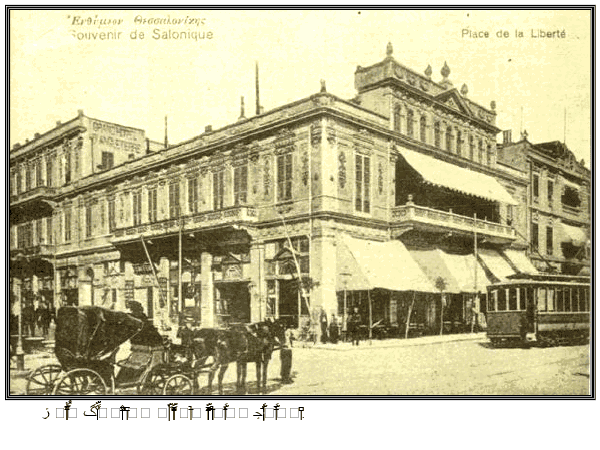
Other topics covered aspects of gender such as the importance of Mary Magdalene whom the Church denigrated as the repentant harlot and the story of Esmeray, a Kurdish transvestite from Kars.  The last talk was based on interviews and research made in Cyprus on gay, and transgender Cypriot people and 'normal' attitudes towards them.   Some other beautiful photographs of Thessaloniki and its architectural changes in the late 19th - early 20th century due to war, earthquake, fire also formed a most interesting discussion.

Old Thessaloniki
My own talk was on my first  book The Long Shadow which was mainly set in Salonika in World War One. Ypres, the Somme, Passchendale and all the other haunting names of the Western Front are well known events, lived over again and again in films and documentaries.  We conjure up pictures of slithering mud, cold trenches and other harrowing scenes of Western battle zones.  But who knows much about Macedonia and the freezing Vardar winds, the barren but beautiful mountains, the treacherous ravines and raging summer heat filled with malarial mosquitoes?  The troops entrenched in Salonika behind barbed wire barricades called it The Birdcage, hence the title of the talk The Barbed Wire Birdcage.  The Long Shadow is a novel that explores the events of the Salonika Campaign through the imaginary diary of a Red Cross nurse with true as well as fictitious events based on letters, diaries, magazines and books of that period.  We see Salonika as a fascinating, multicultural city described through the eyes of doctors, nurses and ordinary Tommies, many of whom laid down their lives there. 
Talking about the Struma Front
It has been a most enjoyable experience.  Thank you all at ACT for inviting me there.


Sunday, April 21, 2013

Elgar's Last Love

Elgar's Last Love

Sir Edward Elgar

There can be nothing closer to a heavenly sound, a world known only in distant dreams and visions, than the slow, exquisite diatonic melody that opens the first part of Elgar's First Symphony. The sound is stately yet haunting; as Elgar would himself say, 'broad, noble, chivalrous.'  His wife Alice called it the 'great and beautiful tune.'  It is more than that; listening to the sombre depth of the woodwind and the haunting long drawn out sigh of the violins and violas sends shivers through me.   It's another world, another land which beckons and awaits one . . . somewhere.  I could listen to it again and again.  He has been called the greatest composer of the symphony there is and I agree with this judgement   It's no surprise to know that this long awaited symphony, played for the first time by the Halle Orchestra in Manchester and four days later in London, met with such rapturous applause. Elgar was called back again and again; the audience would not let him go with many standing up on their chairs in order to see him.

The 'great and beautiful tune' began while he tinkled idly on the piano.  His wife suddenly exclaimed.  'I like that tune' and from then on it remained in Elgar's head for a long time before at last becoming the opening passage of his symphony.  Nor did the symphony itself come with ease.  It seemed to waver always somewhere in the back of his psyche and the opening theme may be said to be his 'soul' sound, held there since a young boy sitting in the reeds by Severn side and heard music flowing through the river, the trees, the air . . .

In an interview Elgar once said, 'my idea is that there is music in the air, music all around, the world is full of it. . . and you simply ...simply...simply...take as much of it as you require.'

Elgar and Alice Roberts

Like all creative men, the 'puer' type, Elgar needed a strong, mother figure in his life to sort out all the practicalities while he could dream, compose, conduct, weave his glorious melodies. I's a great and natural arrangement , one which he found through a staunch, loyal wife.  Alice Roberts met Elgar when he was teaching the piano at Malvern.  He was twenty nine, always a significant age in human life.  She was just turning thirty eight and the daughter of a Major General, a social class way above that of the piano tuner's son.  These foolish social complexities mattered in those days.  However, Alice felt convinced of Elgar's genius and they married despite the disapproval of many, including her parents who refused to attend the wedding.  She ended her life as Lady Elgar so that must have proved her point.
In many important ways, it is Alice we have to thank for Elgar's music.  She was a keen poetess but abandoned her own interests in order to urge and encourage her husband  in his own pursuits.  As she once said, 'The care of a genius is enough of a life work for any woman'. Without her strong and dominant nature, he might never have brought his attention fully to work on longer, deeper compositions; part of him seemed always to want to escape and dream, cycle endlessly around the lovely Worcestershire countryside, gaze from his window at the rolling hills.  So true of the creative type!  The actual production of the work is the hardest part of all and often seems like giving birth, as if something is born but parts from within one's soul, never to return.  The unborn is always full of possibilities, once born it is in some ways already dead.

Like so many creative people, he seldom made much money and had to produce a variety of songs and small pieces to earn their keep.  This is a sad reflection on our modern age which pays much to the mediocre but doesn't foster the talents of the great.  'All about the money' . . . as Elgar would have said despairingly.

Elgar sought for his anima, his soul figure in a variety of women and he in turn was extremely attractive to them. Alice was the rock, the mainstay, the mother figure, but such men need a passionate romantic interest to fire their creativity.  This inner figure is like the mate of the creative spirit, rather than the mate of the body, belonging within the psyche rather than in prosaic outer life.  Projected onto a real woman, it can stir the creative impulses and produce the wonderful 'child'.  There might or might not be physical mating as well.  In a way, that is unimportant, in fact it might even destroy the illusion, the romance.  It is a spiritual quest, the quest of the Troubador. 
Alice Stuart Wortley

Like Dickens, Elgar had a first love when he was a young man.  This girl broke their engagement and left for New Zealand.  How different things might have been if he had made this more ordinary, provincial marriage rather than meeting the strong minded Alice Roberts!  Would his genius have flowered then, one wonders? Elgar was later to meet another Alice, daughter of Millais the Pre Raphaelite painter.  He formed a lifelong romantic friendship with Alice Stuart Wortley and though he, his wife and her husband were all friends, the couple did meet up clandestinely on occasions.  Elgar called this Alice 'Windflower' and dedicated his Violin Concerto to her.  He was fond of putting the sounds of his friends into music as we see in Enigma variations. There is no doubt that the relationship with 'Windflower' was very special to him for many years and Elgar alludes to summer evenings full of romance in some of his letters.
When his wife Alice died in 1920 Elgar was devastated and ceased to write any more after this. 'All I have done was owing to her and I am at present a sad and broken man.'  He wrote to a friend after her funeral. He had lost his driving force in the shape of this strong and supportive woman and he mourned her.  The energy of composition seemed to go with her but it was also his sense of the change in the world since the horrors of the First World War.  He knew nothing would ever be the same again and his music was no longer appreciated by the younger generation who saw him as part of the old regime that had created the war.  George Bernard Shaw deplored the fact that Elgar's music was being neglected and the Shaw festivals were created at Malvern to honour it and also Shaw's plays. Nowadays, Elgar is once more appreciated as a great composer and belongs especially to Worcestershire and the beauty of the great rivers and the rolling Malvern Hills which Elgar loved so much.  He is everywhere here in Worcestershire, his music flows about one as one walks the hills, soft echoing, rolling melodies, gentle as the scenery about one, full of space, light and yet tinged with sadness.
Carice Elgar

Elgar cut off his relationships with many of his previous lady admirers and friends apart from 'Windflower' with whom he kept up a distant friendship, passion long gone.  His only child, Carice, grew closer to him now whereas in her youth she had been sent away to boarding shcools and generally kept out of her father's way so as not to disturb him.  He seemed to feel his time was over, a lonely, unhappy man.  His energies turned to the pursuits of a country gentleman with dogs, horse-racing and walks.  But at the same time, he no longer seemed interested in convention, freer to be himself, one of the joys of old age.
The programme in which Elgar noted their first meeting


Thus he was open and like fallow ground when the momentous story of November 1st 1931 unfolded.  Momentous for him and for a young violinist in the orchestra he was conducting that day.  The date became a part of their private story, a sudden and amazing meeting of soul mates. The name of the violinist was Vera Rebecca Hockman, a sweet natured, gentle, warm, Jewish girl.  She already had a hero worship for the great composer and felt she knew him through his music as if already a part of his soul.  She was thrilled to be among the first violins when Elgar was asked to conduct 'Dream of Gerontius' at the Croydon Triennial Festival. As she played she realised he kept looking at her over and over again and afterwards asked to be introduced to her.  They swiftly struck up a deep loving friendship.  Vera accompanied him often as he couldn't bear to part with her company.  She was a married woman with a daughter but she and her husband had separated long before but nonetheless, conventions required that they kept their unusual (and likely to be misunderstood) friendship fairly low key in the eyes of others. Elgar may have considered marriage but his own daughter Carice was alarmed by the idea although she had no personal animosity towards Vera.  In fact they became very good friends and Carice really enjoyed the other girl's company, a fact she often noted in her diary.  Vera was one of those happy people who brought joy and peace to others.

Vera Hockman 
Elgar said that Vera made him so happy and his great regret was there was so little time due to the vast age difference. He had been a sad and troubled man all his life but this warm, accepting, tender woman was able to give him this joy in his old age and remained with him till he died in 1934.  The feeling she created in him at last brought him out of his creative lethargy and he began to compose the Third Symphony, dedicating one of its movements to VH.  He said that she was 'my mother, my child, my lover and my friend.' 

How wonderful a tribute for any woman.   How I envy her!

The Third Symphony sadly remained unfinished, a 'great tragedy' as T.H.  Lawrence put it. Perhaps in another world, Elgar and Vera may meet and the symphony finish there.  It's a nice thought. 


Favourite Quotes

  • My home is my retreat and resting place from the wars: I try to keep this corner as a haven against the tempest outside, as I do another corner of my soul. Michelle de Montaigne
  • Happiness is when what you think, what you say and what you do are in harmony: Mahatma Gandhi
  • Friends are people you can be quiet with. Anon.