Wednesday, November 18, 2009

Dark Nights and Delicious Books


Dark wintry nights are closing in. It should be an ideal time in which to read good books. No distractions from the window of sunshine on the Malvern Hills beckoning me out for an evening walk. No prospect of sitting out in the garden and watching the birds and the bees. Now it's just darkness out there and glittering little orange lights on the hills to indicate the fact that everyone is tucked up indoors. Probably on FaceBook or Twitter.

So to enjoy these dark nights with all this time to read, I took myself to London and the Diiarts launch of four fabulous new authors. Diiarts,or Dragon International Independent Arts is a new imprint and one to watch as they may in time turn to varied publications besides books,perhaps music, art and so forth. Take a look at their website www.diiarts.com. The launch was held at a most interesting venue, the London Canal Museum, near King's Cross Station. I hadn't even known of the existence of this place till now and will have to return at a quieter time to see its wonders. There were barges, a replica horse (stuffed, drugged?) and all the cheerfully painted accouterments of canal life in the olden days.
There was little time to explore all this as,with wine flowing nicely,there were lots of friendly familiar faces from the Harper Collins site Authonomy to talk with and to enthuse over everything. Some had come all the way from the States and New Zealand and were making a holiday of it, such is the enthusiasm for this new imprint. It's talented authors are like good,familiar friends, their books our books, their words our words as we have all helped one another to shape our creations with criticism, praise and even a few sibling-like quarrels and boozy Friday night flirtations. Authonomy is where we met and where the concept of Diiarts was conceived. So some good came from all our varied authorial nit-picking labours! I came home armed with a couple of tomes and am getting well stuck now into May 1812 by M M Bennetts. That'll keep me going right through the Napoleonic wars.

But somewhere I'll have to stop all this blogging and reading and Facebooking and emailing and ..yes, deal with the first proofs of The Crimson Bed. I'm a bit scared. Will I still like this novel? Of course, it's brilliant. Isn't it? Oh well, off I go to do some work on it and lay my intriguing book aside for a bit.

BTW if you want to hear my podcast about the book...where I sound as articulate as a footballer's wife or a lead guitarist of the 1960's... try this site! The actress Tessa Nicholson (who recently appeared in the first episode of BBCI's 'Garrow's Law')reads extracts from the book beautifully in contrast to my sad mumblings!

http://lorettaproctor.shortstoryradio.com/

Friday, November 06, 2009

No Time to Stand and Stare?


There's a real problem these days. It's called Facebook, Twitter, Blogs, Skype, mobile phones and email. All these are fine and fun and useful in their way but they take up time from actually living life. You see apparently demented people walking along a city street jabbering and gesticulating as if to themselves. They don't look around to see that it's a beautiful sunny day, skies are actually blue for once, the breeze is blowing autumn leaves along the pavement, the birds are singing in the trees that shed said leaves . . . they don't observe with interest and amusement the sight and sound of the many faces and interesting characters they pass on their way around the busy shopping malls, or take time to wander thoughtfully along the riverside of some fine old town like Worcester. Basically they don't even notice they're alive half the time. Talk-talk. That's their life. And the talk is all nonsense most of the time. Sad.

I'm just as guilty as everyone of indulging in all this displacement activity though.

In an Oxfam shop the other day I came across a 1930's blue hardcover reprint of Wilkie Collins masterpiece 'Woman in White' and a mere snip at £3.00. I took it to the girl at the counter who waxed lyrical for ages. 'It's a wonderful book, ' she said,' I couldn't put it down, read it right through from start to finish and no time to eat or anything. You'll love it, it's well worth the money, a lovely book.'


I paid for it and agreed with her that it was in great condition and said that though I had read 'Moonstone' I'd never read 'Woman in White.'

'Oh, my goodness. You won't regret it. It's a lovely book, ' she said,' I couldn't put it down . . . I really couldn't put it down.' . . . I escaped while she was still rhapsodizing.

However, I had to agree with her. It's a long, detailed book and took even a fast reader like myself some days to get through. It is one of those stories that lingers in the back of your mind and impinges on your daily activities, making you hurry your tasks till, like some delicious confectionery you are allowed to dip in, enjoy and savour the moment of indulgence.

The characters are unforgettable, fascinating and vivid. The atmosphere is enthralling from the start as the fearful, agitated 'woman in white' glides into Walter Hartright's life, arousing his pity and protectiveness.


The beauty of a long, detailed book such as this is that the characters have time to develop. They impinge on the mind and stay with one forever because one really gets to know them with all their little quirks and foibles. What could be more unforgettable than the vision of the incredible Count Fosco sitting with his little canaries, teaching them to hop from one fat finger to another and then bidding them to sing when they reach the top of the 'ladder' made by his hand?

There is no lack of action in this story though it's not of the manic, helter-skelter kind of modern writers such as Dan Brown where characters are of little importance except as vague vehicles of the frantic activity and death dodging dangers of the plot. Locations if anything seem more important than people in such a tale and the wierder the locations the better.

There is also time to be philosophical in a long, detailed story. But where do philosophies fit in any more in the fluttering, ephemeral, chattering, meaningless world of twitter, facebook, i-pods?

Sunday, October 18, 2009

Case of the Disappearing Lorri


Due to losing a variety of hard drives, new computers, time spent writing, reading, travelling, playing...well, any old excuse really...I lost/forgot my blogspot and need to do a little catching up.
Research is half the fun when it comes to writing a book and my study of Dante Gabriel Rossetti has led me into some wonderful places. At the Ashmolean I was able to look at some of his work, read Lizzie Siddal's scraps of poetry and study her delicate, thoughtful drawings and paintings. At the Bodleian, I immersed myself in Holman Hunt's and John Ruskin's correspondence as well as many other intriguing Victorian letters and diaries. It's dipping into another world. And a world that is nothing like the recent BBC effort on the Pre-Raphaelites which showed them as boozing, womanizing fools. As some wit at the Pre-Raphaelite Society put it, the series should have been called 'carry on bonking up the easel'.

Poor Rossetti would have turned in his grave. He was hyper-sensitive to a degree and hated any criticism. In fact it was due to his long running altercation with a critic called Thomas Maitland (his real name was Robert Buchanan and he had attacked Rossetti before) who wrote a damning piece about him called 'The Fleshly School of Poetry'. In this lengthy, vitriolic, below the belt piece of journalism, Buchanan accused Rossetti, Swinburne and William Morris and their poetry as 'the mere fiddledeedeeing of empty heads and hollow hearts.'
Rossetti, nerves already strained by illness and tragic events,began to fall apart at this attack. Sadly, rather than ignore the matter and forget it, he was roused to such rage and vengefulness that he attacked Maitland back with a riposte entitled 'The Stealthy School of Criticism.'

Never a good idea. Eventually the whole thing blew out of proportion in Rossetti's mind and led to his increased drinking, sleeplessness and chloral taking. Yet in his youth he was a serious man, never drank at all, was scholarly and intellectual. He was not a womaniser by any means. His two great and idealised loves, Lizzie Siddal and Jane Morris, were by no means prostitutes that he or his friends had picked up from the streets nor were ever treated as such. It is so sad that modern writers feel they can twist a dead person's reputation to suit their own dramatic purposes and the expectations, attiudes and prurient curiosity of the time. But I suppose there's nothing new in that. It's just sad.
Photo of D.G. Rossetti

Sunday, September 10, 2006

The Price of Fame


Lately, as I send my little novel out into the big wide world, looking for a home, I have debated what it means to be creative. And about Fame and what a strange, elusive, nonsensical thing it is.
Sitting reading Sunday papers in bed today, I read an article on David Hockney, the artist, and how he was doing this mind-bogglingly inventive thing of painting outdoors. His work now looks very Van Gogh but nothing like as brilliant. Basically any teenager could have painted these Hockney scenes. Yet he is famous and these pictures will sell for lots and lots of money. Van Gogh? Well poor old Victor died mad, died young, died penniless and lonely. He was in the wrong era. By the time of his death he was just beginning to be appreciated and understood. Now he's worth millions but what good was that to him when he was never to know that his pictures would be admired, loved and iconic?...Sunflowers say?. Everyone knows his Sunflowers.


I thought too of Rossetti whose life I am still studying for my work The Crimson Bed. He insisted on painting his own way, refused to have public exhibitions, never made it as an RA and never wanted to either. Millias, however (the original founder of the Pre-Raphaelite Brotherhood along with Holman Hunt) lost his original and individual spark, became popular, famous, met the Queen, became an RA and was knighted. Who thinks much of his pictures today? Would anyone want Bubbles and Cherry Ripe over their mantelpiece anymore? But Rossetti still fascinates us with his senusous, dramatic pictures of beautiful women and intricate, symbolic, archaic pictures of mediaval times. He had something that was oddly timeless.

Poor Rossetti also died young and penniless from drink and drugs which he took to help cure his sleeplessness and general state of nervous paranoia. Millais died in comfort.
Hmmm....which would I go for?

If one truly aims for Fame, then you want it in this lifetime and want to know about it. However, if Fame refuses to touch you with a bargepole, it would be nice to dream that one's manuscripts might be discovered in a cupboard someday and become famous posthumously.
Dream on.

picture: The Wedding of St. George and Princess Sabra by D.G.Rossetti


Monday, August 07, 2006

The Demons within


In all my writings I seem to find myself exploring the tremendous force called creativity. It is an energy present in all things.


In Nature, of course, it comes forth physically, urgently, in order to keep the species going. In human beings it is equally present in this physical manner but we are unique in having another form of creativity which arises from the soul and spirit, an inner creating of brain children. We, like Zeus, can produce our creations from our heads, fully clothes and armed like his daughter Athena. And it is a most impelling urge that can actuallly eat one up from within. It partakes of the gods and the Gods have a way of taking us human beings up and working through us in however small a manner . . . and once they decide to take us up, we are done for!


Creating is inspiration, something we take in . . . 'inspire' meaning breathing in. It comes in with our first breath. It never leaves those who are destined to be impelled by its driving force; such are obliged to write, paint, sing, act till they are exhausted. We see this in the Hans Andersen's story of The Red Shoes which, once put on, could not be taken off and made the little girl dance on and on till she dropped dead of exhaustion.


Creative types will recognise this strange ailment and its effects! Take Julie Andrews. She has been singing since she was a very small girl and has always inisted on perfection, singing right into her old age and until a throat operation made it no longer possible to sing as she once did. She probably feels as if she has no purpose in life any more.

I assure you it can be a demon and may well be why so many actors, artists, writers and poets die young or turn to drink and drugs. These demons have to be exorcised somehow, the mind has to stop its maddening flow of words and images . . .


Feel another story coming up. Hang on let me get some paper . . .

Saturday, July 29, 2006

Nothing puts of a determined writer!


It has been so hot. Is this England we ask ourselves as we sit outside cafes sipping lattes and watching the sun dancing and shimmering on the pavements? The garden looks as if it has gone in for scorched earth policy. Yet amazingly flowers still bloom and from somewhere the trees manage to find water and look green. Nature's resistance and adaptability never ceases to amaze me. But how much can it take of this drought? I would hate it if our lovely green British countryside was to be no more and we turned into a barren landscape like Andalusia.
Suprisingly the one thing I can do in the heat is write. It is a sitting still occupation plus an absorbing one. So I pull down the blind, put on the fan and leave the heat behind while I cry and laugh and get excited with my hero and heroine. And, folks, I have finished it! (see last blog) The Crimson Bed (present working title) is all done and now being revised. So let's hope some agent feels it's the best thing ever to fall onto his/her doormat.
It is a tale set in Victorian London of 1853-62 and the story intertwines the fortunes of Gabriel Dante Rossetti and Lizzie Siddal with Frederick and Eleanor Thorpe (my hero and heroine) whose romances are contrasted with one another and yet have strangely similiar echoes. Lots of drama, passion, suspense.

So dear agent, please enjoy!


The picture shows Rossetti's drawing called How They Met Themselves. The doppelganger is a presage of death ... an odd thing to draw at such a time. It has always fascinated me and I personally see it more as an alchemical 'quaternio' a meeting with one's Higher Self or with one's Shadow self.

Thursday, July 20, 2006

Crime and Romance

Sorry folks. I’ve been a busy girl this month. Lots going on and the latest scorching weather is just melting me into a soggy pool and turning my brain to mush. I can’t move an inch without breaking into a sweat so have been sitting on my chair with a fan going and reading Agatha Christie novels.

I ought to mention going to London a short while ago for the CWA Golden Daggers Awards. My daughter Thalia and I went together hoping to see a mutual friend, Laura Wilson, win the big prize. Laura was shortlisted amongst the final six which is an achievement in itself. Her book A Thousand Lies is a stunner.


I met Laura some years ago when she was about to go to University. She was a cheeky, chatty, punky young lass with hair standing on end but now . . . she is a calm, cool blonde, elegant and utterly beautiful. Sadly, she didn’t win the prize and I totally forget who did as I was so cross about it. It would have been a nice £20.000 for Laura!
Then off to the Romantic Novelist Conference at Penrith in Cumbria, a glorious location. This was my first conference and I thoroughly enjoyed it, picked up lots of tips and hints and expertise from the speakers. The RNA is well known for its friendliness, the help members give one another and general air of comradeship rather than belligerent competition. But then a Romantic Novelist must surely be ruled by Venus, Goddess of Love so you’re generally going to find a co-operative and helpful bunch under her rule!

And at 12. noon on Monday 17th July I finished the first draft of The Crimson Bed my latest novel. Always a sublime moment of birth and an auspicious time at noon when the Sun is at its zenith. I feel like a Mum who has just given birth and, as with all births, now comes the real hard work! Glaring discrepancies already stare at me and so off I go to sort them all out before some cruel editor swoops upon them.

Crime and Romance are strange partners and the bookshop that has both used to be Murder One in Charing Cross Rd. London, now sadly closed. But there's always Goldsboro Books in Cecil Court, London with their signed first editions!

Tuesday, June 20, 2006

A Strange World: Jonathan Strange and Mr. Norell


So this is the adult version of Harry Potter. I don’t think so.
It is a unique work, bordering on genius. And like all works of genius neither easy to read nor comfortable to understand. It reminds me of Munch’s painting The Scream or James Joyce’s book Ulysses. These are iconic works; they are unique, make a statement and are brilliant but who would ever want The Scream facing him on his or her sitting-room wall or feel a desire to keep re-reading Ulysses?
JS and Mr. N is a marvellous work but not pleasurable...at least not for me. I skipped a lot of it as it was far too wordy and I am surprised Ms Suzanne Clarke was able to get away with it for a first novel. I think she floored everyone with the sheer volume of her ramblings.

It is such a Neptunian tale; mists, faeries, shape-changing, magic, other-worlds…it is a labyrinth with all its mazes and twists and turns and paths that lead to nowhere until one stumbles at last on the path that takes one to the dark central figure, the Raven King, who might well be the Minotaur, who knows? I feel I understand the story of the Minotaur far more since reading this book. The Raven King is also a very Arthurian figure too…also Saturn, who is said to be the King of these Isles.
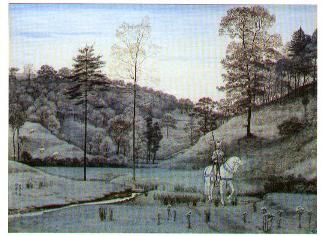
The Raven or Crow is a bird associated since ancient times with the god Saturn. Saturn is embodied too in the element of fear and anxiety that underlies the tale and in the constant wintry landscapes, the snow, the grey mists, the utter dreariness. It is the most colourless story I have ever read and I have here a picture of a landscape that just suits it.

This grey world seems to be the world of borderline consciousness in which one sees strange visions and knows things that are not known in the sharpness of daylight. It is twilight, dawn, the brief moment when all is still and nothing stirs, not a leaf or a branch. We are told that it is auspicious to meditate in this time of utter stillness.

However a book isn’t just written as entertainment. A really brilliant book should be saying something or leaving one altered in some way. I know that I shall always recall this book and it will not be one of those that we read and then forget in a week or two. It isn’t perfect. It really should have been cut down and many of the elaborate footnotes left out. A few brief footnotes would indeed have given the desired illusion of reading an old tome but not so many. At times there is a little too much indebtedness to the speech in Jane Austen, Charlotte Bronte or Henry Fielding. But fair enough, the sense of the Georgian period is there without intruding too much. I think it is a work of true magnitude and will become a classic. It is certainly a challenge to Philip Pullman’s work and perhaps in many ways better.


Friday, June 09, 2006

Best Way to be Cool

In hot weather like this what is the best thing to do? Go swimming, lie in a cold bath? No, go to a lovely, cool, old library building. Okay, I know you think this sounds mad but truly, it was the coolest place to be on Thursday.
I rose early, caught the train to Oxford. It's a lovely journey from Malvern and the hedges were full of dog rose and the railway banks white with ox-eye daisies. Once in Oxford I went to the Bodleian and wrestled with admission procedures. Somehow I managed to get my admission form all wrong (who would have thought I was once a civil servant?) but the lady at the desk was very helpful and understanding. Maybe she realised I would have burst into tears if she hadn’t let me go through on a mere technicality as I had ordered lots of marvellous papers in advance which I was longing to look at.
I wasn’t disappointed either. After depositing my bags, I took myself off to the Modern Papers Reading room (pencils only) and was received by a lovely young man called Paul who was on duty that day. He was so helpful and I needed help as I have never been a graduate or student at Oxford and they do have some rather strange ways of cataloguing their stuff. The collections of letters were well wrapped in large grey boxes and I very tenderly and carefully removed them and laid them out. Then I sat in the lovely cool room at my desk and was lost in a world of Victorian painters till lunchtime.
Reading the letters of people like Rossetti, Holman Hunt and Ned Burne Jones is a marvellous experience. Simply to read them in a book (though easier to understand as most of the writing is diabolical, often criss-crossing and weaving all over the pages) is not the same as actually seeing their script, getting a feel of their character from the way they write, the way they space out their letters and how they express themselves. The real letters are filled with the mana of the writer and it made me feel so strange to hold in my hand these epistles from Dante Gabriel himself and see his dark, expressive face in my mind’s eye, feel the movement of the pen as he wrote in large, rapid, bold hand, stretching now and them to the inkpot to replenish the ink.
I look forward to my next visit and to losing myself yet again in this world long gone and yet still so haunting and atmospheric.

Wednesday, May 31, 2006

Writing about Ghosts

Writing books is a strange thing to do. Inventing worlds of one’s own to live in. My very first novel at the age of 16 was called My Little World and that happened to be in Camden Town for some reason. Maybe because a lot of Greek people lived there and one of my characters was a Greek girl. Maybe because I'm half-Greek myself . Some people live in very strange worlds if their books are anything to go by. Don’t tell me anyone invents the characters from thin air or mere observation of others. That may play a part but then one has to ask…what is it about a particular person that intrigues, interests, captures your imagination? Is it not a resonance with something in yourself? These people reside inside the psyche and are like voices or like ghostly presences that float around in the mind all one’s life. Writing is actually a form of exorcism…the ghosts have to be given life and form, they have to speak out.

I once went to a past life workshop run by a Jungian therapist called Roger Woolger.
(see http://www.rogerwoolger.com This took place at Runnings Park, a beautiful venue that once existed in West Malvern. It was my very first visit to Malvern and I fell in love with the hills and the quaint Victorian town, once a healing spa, still famed for its pure springs and waters. Little did I know I would come to live here one day but I suppose deep down the pull began at that very first view of the ancient Malverns from the train. The sight of them actually made me weep with some sort of soul yearning. It seemed the only place to be at peace.
Now I look out from my window and see them every day. They never fail to soothe my spirit.

At the past life workshop, I encountered a lot of strange people, some inside my own soul, some around me in physical forms. I do believe in reincarnation but to this day don’t know if what I experienced so deeply was memories of past lives or bits of my psyche telling their story. Writing is just like this. One writes almost in a trance state sometimes and the characters begin to speak. They know exactly what to say to one another and where they are going. The conscious "I " hasn’t a clue half the time. The plots take their own twists and turns and refuse to follow any pre-ordained notions of what is going to happen.
I still keep re-writing My Little World and it changes plot every time. It’s all summed up in my favourite quote from Ignazio Silone

‘ I would willingly pass my life writing and re-writing the same book…that one book every writer carries within him…the image of his own soul’

If you are interested in writing tips take a look at Neil Whiteland’s blog.
www.writing-a-book.blogspot.com

Tuesday, May 23, 2006

God or the Devil? .....His Dark Materials


Although I couldn’t put Northern Lights down, something about this trilogy was strangely annoying. Lyra lives up to her charismatic name as the constellation of The Harp that lures and enchants everything. Apparently Lyra, the harp, was the one given to Orpheus by the Sun God, Apollo. Orpheus was the one human being besides Psyche to be allowed down into the Hades, the Greek Underworld where the dead went and lived as ghosts. Pullman's young heroine, Lyra, unlike Orpheus, manages to return again and even to free the ghosts and allow them to escape their terrible limbo world. They become part of the conscious atoms and particles of the Universe. There’s some really deep stuff here.
The concept of the daemon was brilliant. I suspect most of us do intuit another person’s “animal” inner being. It’s a kind of gut feeling. Someone looks ‘horsey’, is a ‘pig’ or a ‘bear’, behaves like a ‘mouse’. But in Lyra’s world they are real, separate birds and animals who can talk with you and accompany you. How lovely a concept! We would never feel lonely if we could be in contact with this inner being, would we? I like to imagine mine sitting here with me now. I think my daemon is a Snowy Owl. I have pictures of Snowy Owls by the computer. The picture shows a strange dream I had once of a beautiful owl with one white wing and one black wing against a pitch black sky. It felt a very important dream then and now. Was this my daemon?

Pullman’s second volume, The Subtle Knife, was also enthralling. A knife that, like reason, cuts through everything and opens the mind to other worlds and ideas yet is broken and destroyed as soon as emotion and indecision take hold. Total concentration and one-pointedness are necessary to use the tool of the mind. This weapon belongs to thoughtful, clever Will, Lyra’s male counterpart. The story begins to get very adult and more complex now. It certainly isn’t childlike. But I really struggled with The Amber Spyglass, the last of the trilogy. It was sci-fi and weird, the ideas too complicated and confused and the peculiar entities Pullman invented just didn’t have the sense of reality and loveableness that Tolkien gave his imaginary beings. The Mulefa just never did it for me; they were too unlikely.

Pullman is the son of a vicar. No surprise there. Often the most anti-church people are. It’s called rebelling against authority and God the Father is, I suppose the supreme authority. And when Pullman banishes him forever, we end up with a Republic of Heaven. Hmmm…

It’s a great book for all its flaws. A brilliant concept and remains in my mind and still makes me puzzle and think about it as a truly great book should.

Lorri (
www.lorettaproctor.co.uk)


Friday, May 19, 2006

Heavenly Vaults and wonderful Spaces


I visited the British Library the other day to do some research on my next novel, The Crimson Bed. This is to be set in Victorian London with a Pre-Raphaelite background. So I spent a wonderful few hours reading the letters of Dante Gabriel Rossetti to Jane Morris and Fanny Cornforth, two of his great friends and loves as well as the inspiration for many of his later pictures in oils of sensuous, lushly beautiful women. The British Library at Euston is a very modern, spacious building and well worth a visit for the exhibitions and the shop where great goodies are for sale for the book lover.
But oh, how I do miss the Round Room of the old Library that used to be at the very heart and centre of the British Museum at Bloomsbury! There was nothing to compare with the sensation of climbing up the steps of the Museum as if entering a great temple. Then passing through the milling, excited, noisy throng in the hallway and through the barriers and into a peaceful, quiet, spacious room that took one’s breath away. It was totally round, a glorious eggshell-blue in colour, and above one rose the high, gold-decorated dome like some heavenly vault. One sat in a leather chair at a leather covered desk with one’s precious books and the thought was always there…did Dickens sit here, or Karl Marx or any other great writer who has used this hallowed room? It made me think of my author acquaintance, Colin Wilson, who used to spend his time there as a penniless young man, sheltering from the elements and writing The Outsider, his famous book of the 1960’s which earned him the dubious title of “Angry Young Man”.
To be amongst these men and women was to be among the great and surely this would rub off even on me?
Speaking of heavenly vaults makes me remember a dear friend called Bill Bendon whom I knew in my early teens. He was then in his fifties, a real father figure whom I loved very much. One night I dreamt a vivid dream. He came to me in this dream and taking my hand we rose upwards into a beautiful golden vault full of light and beauty. I felt so incredibly happy there. A few days later a friend rang to say Bill had died.

Tuesday, May 16, 2006

John Grisham moments


With nothing to read one day I thought I would tackle a John Grisham. My husband has collected the lot and loves them, so I thought... let’s see what the attraction is for him in these books? The first one I picked out was The Testament. I was immediately hooked.
The story is about a dying millionaire who alters his will at the last moment, cutting out all his greedy scheming wives and children and leaves it all to an unknown daughter. All that is known is that she is a missionary somewhere in the Brazilian jungle. A young, rather down-and-out lawyer, with a drink and depression problem
is sent off to find her. He has nothing to lose and the dangerous mission could prove lucrative and save his bacon. After much detective work and many adventures, he finds the girl. Meeting her changes his life and alleviates his sense of despair.

It is a wonderful story with tense and dramatic descriptions of navigating the Brazilian waterways and of the tribes of the jungle with their Stone Age, almost meaningless, half-human existence. The character of the girl is truly inspiring and the whole story upbeat and spiritual, a tale of hope and love. I felt deeply moved by it. Grisham writes in simple, succinct prose and has no un-necessary sex or violence yet the story is by no means prissy. I was so impressed I went into a John Grisham binge and read virtually all the others. The general theme that runs throughout his body of work is about the individual little man or woman up against the impersonal, ponderous, manipulative machinery of finance, law, politics, drug companies etc. There is always a legal or court case involved and these can be skippable, but are necessary to give credibility. The pace of the books is good without being frantic, the characters believable and the tone moral without being patronising. Grisham is a committed Christian and this comes over in his stories which favour the underdog and have sympathy for the hard life that turns some people to crime. Go out and get a Grisham ...you won't be able to put it down.

Wednesday, May 10, 2006

Books and Other Things


This is a book family. Everywhere I look I see books, big ones, small ones, old ones, new ones. Some quite arcane ones too full of mystery and magic. I had a Celtic spell some years back and King Arthur and Merlin smile at me from my Arthurian shelf. But since I moved here to the West Midlands, I am surrounded by magic and beauty and the longing for distant realms which I had in London has been assuaged. So I don't look at those books anymore. All the same, I won't part with them. They are filled with such beautiful pictures. Images and books should go together in my opinion. That's why modern books are such a bore. They have no pictures.
The Victorians got it right. That was a period of some of the loveliest book illustration there ever was.
Back in the late forties, my Dad, who had an eye for books himself and collected them avidly, bought me an illustrated Arabian Nights. I loved this book so much. It was a large one and the pictures were uncoloured etchings. I coloured some in myself and gazed and copied and dreamed with this book so much that the covers fell off. We were always on the move in my youth and eventually during one move or another the book was lost. (Or Ma threw it away, which is more like it) Now I really regret that I misused this beautiful Victorian book so badly. It's worth a bomb now. I saw it in an Antiquarian bookshop and had a hell of a shock.
But I loved it so much. And in the end what are books for but to give joy and pleasure and use? Not to sit unread on shelves surely?

If you want to read about my own book The Long Shadow and The Crimson Bed see www.lorettaproctor.co.uk

Favourite Quotes

  • My home is my retreat and resting place from the wars: I try to keep this corner as a haven against the tempest outside, as I do another corner of my soul. Michelle de Montaigne
  • Happiness is when what you think, what you say and what you do are in harmony: Mahatma Gandhi
  • Friends are people you can be quiet with. Anon.